Yoga and Meditation Retreats in Sri Lanka
On a map, Sri Lanka looks like a tiny teardrop off the coast of India, but on the ground it feels like an entire universe of Yoga, Meditation, Ayurveda and slow, spacious days. From jungle-canopy shalas where cicadas hum through evening practice, to silent forest monasteries and barefoot sun salutations on empty beaches, the island has become a magnet for travelers craving wellness, mindfulness, and a gentler rhythm of life. Many visitors arrive exhausted from screens and schedules, only to find themselves resetting their sleep, rediscovering appetite, and shedding layers of stress in a matter of days. With deep Buddhist roots, village traditions of herbal healing, and a culture that still values simplicity, Sri Lanka offers something more than a holiday: a retreat that nudges body and mind back into alignment, with plenty of surf breaks, spice gardens, and coconut palms along the way. 🌴
Key points about yoga and meditation retreats in Sri Lanka
- 🌊 Diverse landscapes – From misty hill-country tea fields to laid-back surf bays and rainforests, every region offers a distinct backdrop for Yoga and Meditation practice.
- 🧘 Retreat styles for every traveler – Vipassana monasteries, women’s forest sanctuaries, surf-and-yoga camps, Ayurvedic detox, and nature-based community retreats all coexist on the island.
- 🌿 Strong spiritual lineage – Centuries of Buddhism and Ayurveda shape daily life, making mindfulness, ritual, and natural healing feel woven into everyday moments.
- 💸 Excellent value – Compared with many global wellness hubs, retreats in Sri Lanka tend to be more affordable, especially for longer stays and immersive Panchakarma programs.
- 🤝 Community connection – Many centers support local teachers, farmers, and artisans, so your retreat can directly benefit nearby villages while you unwind.
- 🌍 Perfect for slow travel – Retreats fit beautifully into a wider itinerary that might include nature, culture, or other Asian wellness hubs like wellness escapes in Thailand.
Yoga and Meditation Retreats in Sri Lanka: Why This Island Feels So Healing
Ask returning visitors why they keep circling back to Sri Lanka for Yoga and Meditation retreats, and a pattern emerges. People talk about a kind of softness in the air, the way strangers on buses still smile, and how easy it feels to unplug. The island may be small, but its mix of lush nature, ocean horizons, and spiritual history creates a rare environment for genuine relaxation and inner reset.
Much of this atmosphere comes from its Buddhist heritage. With a large part of the population identifying as Buddhist, everyday life quietly normalizes mindfulness: incense in village shrines at dawn, saffron-robed monks moving through markets, local families pausing at roadside stupas. When travelers step into a retreat, they step into a culture where slowing down and watching the mind is not a niche hobby but a respected path. 🕯️
Another reason the island feels so restorative lies in its biodiversity. In one week you can practise sunrise yoga beside rice paddies echoing with birdcall, sit in meditation in a forest hermitage, and close your eyes to the roar of the Indian Ocean. Many retreat programs intentionally move practices outside the shala: walking meditations under jackfruit trees, breathwork on boulders beside jungle streams, or simple body scans lying under the stars. That contact with wild spaces recalibrates nervous systems that have forgotten what “off-line” feels like.
Travelers often arrive carrying more than jet lag. Burnout, broken sleep patterns, emotional fatigue, and a sense of disconnection from their own bodies show up again and again in intake forms. Retreat hosts on the island have grown used to guests who think they just “need a break” and only realize a few days in that the body has been running on fumes for years. Daily Yoga sequences, no-phone afternoons, and unhurried meals of rice, curries, and fresh fruit start to reverse that pattern surprisingly quickly.
There’s also something quietly motivating about being in a country where wellness doesn’t necessarily mean luxury. Simple forest ashrams and family-run centers sit beside high-end Ayurvedic resorts, but the thread between them is the same: a belief that spiritual growth and healing are accessible if you’re willing to show up, breathe, and be honest with yourself. That mix attracts backpackers, remote workers, honeymooners, and long-term seekers who might never have considered a retreat elsewhere.
For many, their first taste of structured practice comes here: rising at 6 a.m. for meditation and breathwork, joining gentle Hatha in a jungle shala, or sitting through a silent evening session while geckos chirp overhead. The island turns those routines into something sweeter and less forced, simply because life outside the gate is already slower. By the time travelers board their onward train to Kandy or their bus back to the coast, most carry a notebook full of new habits rather than just a camera roll of palm trees.
All of this makes Sri Lanka a rare place where Yoga, Meditation, and daily life don’t feel separate. Retreats here act as bridges, helping visitors cross from stressed-out schedules to a more grounded, intentional way of being.
From Rat Race to Rainforest: A Traveler’s Turning Point
Consider Lena, a Berlin-based designer who landed in Sri Lanka after a brutal year of deadlines and insomnia. She booked a ten-day nature-focused retreat near Thudugala almost on a whim, expecting “some stretching and good food.” Instead, she found herself falling asleep without medication by day three, crying unexpectedly during an evening meditation, and rediscovering the taste of food made from ingredients grown a few meters away.
The retreat’s routine was deceptively simple: sunrise breathwork, mid-morning Yoga, silent breakfasts, afternoon journaling, river swims, and nightly group sits. No grand revelations, no pressure to perform advanced postures. Yet by the end Lena had redesigned not her website, but her week: phone-free mornings, home-cooked meals, and weekly mini-retreats with friends. Her story is typical of the kind of shift that this island quietly invites.
Such personal turning points explain why Sri Lanka keeps showing up on wellness travelers’ shortlists alongside places like Bali or Thailand. Those looking beyond the island sometimes compare itineraries with options such as budget-friendly wellness escapes in Bali, but many end up choosing Sri Lanka precisely because of its smaller scale and more intimate feel. Here, change feels doable, not distant or theoretical.
Ultimately, the power of these retreats rests in their simplicity: daily contact with nature, basic but profound mindfulness practices, and human connection layered over a culture that has quietly valued contemplation for centuries.
Types of Yoga and Meditation Retreats in Sri Lanka for Every Kind of Traveler
Once travelers decide to book a retreat in Sri Lanka, a new question appears: which kind? The island hosts a surprisingly wide spectrum of experiences, each blending Yoga, Meditation, and wellness in different ways. Rather than a single “right” choice, there’s usually a right season of life to match a specific style.
At one end of the spectrum, silent Vipassana-style centers and forest monasteries offer structured, no-frills immersion in mindfulness. Days often begin at 4 or 5 a.m., with long periods of sitting and walking meditation, simple vegetarian meals, and very little talking. Phones are handed in, books stay in bags, and the only entertainment might be watching a lizard cross the path. That intensity can be confronting, yet many guests describe it as a reset that strips away distraction and reveals what’s been bubbling under the surface.
On the other end lie surf-and-yoga retreats by the southern beaches. Places around Hiriketiya, Talalla, and Dikwella pair morning Vinyasa or Hatha sessions with afternoon surf lessons, breathwork, and sunset Nidra. These programs suit travelers who want relaxation and play alongside their inner work: think laughter over coconut curries, salty hair, and the satisfaction of catching your first green wave before an evening meditation on impermanence and the sea. 🏄♀️
Between those poles sit nature-based retreats that weave gentle Yoga, breathwork, and Ayurvedic routines into everyday living. Hill-country centers near Kandy or in remote villages like Thudugala focus on community, shared meals, and contact with nature: forest walks, river dips, and cooking classes using garden herbs. These places attract solo travelers, couples, and groups who want depth without rigidity — a space where it’s okay to laugh in class, ask questions, or skip a session to nap under a mango tree.
Female-only retreats have also blossomed, often in forested areas close to Kandy. They combine trauma-sensitive Yoga, circle sharing, herbal steam baths, and workshops on boundaries, creativity, and body image. For many women, this kind of container feels safer than mixed groups, especially when traveling solo or recovering from life changes. Sessions might include gentle restorative flows by candlelight, cacao circles, or journaling under banyan trees, reminding participants that healing doesn’t have to be solitary.
Longer Ayurvedic immersion retreats, such as 14-day or 21-day Panchakarma programs in the Western Province, take a deeper dive. Guests receive individual assessments from Ayurvedic doctors, tailored diets, daily oil massages, herbal treatments, and carefully sequenced Yoga and Meditation classes. Detox can feel intense — there are often days of emotional release or physical fatigue — but those who commit often leave with glowing skin, improved digestion, calmer minds, and a library of self-care practices.
Retreats that blend cultural immersion with practice add another layer. Around Kandy and central Sri Lanka, some programs invite guests to visit temples at dawn, join village ceremonies, or learn traditional rice-and-curry cooking between asana and mindfulness sessions. Participants might spend mornings on the mat and afternoons hiking to waterfalls or painting mandalas, discovering that spirituality can show up in cooking rice as surely as in sitting cross-legged.
To get a feel for this variety at a glance, consider how different styles match different needs.
| Retreat Style ✨ | Best For 🧘 | Core Focus 💡 | Energy Level 🔋 |
|---|---|---|---|
| Silent Vipassana / Monastery | Seekers craving deep mindfulness and discipline | Sitting & walking meditation, simple living, introspection | Mentally intense, physically minimal ⚖️ |
| Surf & Yoga Beach Retreat | Active travelers, ocean lovers, social groups | Vinyasa, surfing, breathwork, playful relaxation | High physical energy, light-hearted 😄 |
| Forest Nature Retreat | Burned-out professionals, creatives, digital nomads | Gentle Yoga, mindfulness in nature, community living | Balanced, deeply restorative 🌿 |
| Ayurveda Panchakarma | Those needing long-term healing & lifestyle change | Detox, tailored diet, therapeutic treatments, soft movement | Varied: physically and emotionally intense, low-stimulus 🕊️ |
| Women’s Wellness Retreat | Women seeking safety, sharing & empowerment | Trauma-aware Yoga, circles, creative processing | Gentle to medium, emotionally rich 💗 |
Having this landscape in mind helps travelers choose not just a place, but a process that aligns with their current chapter. Someone fresh out of a breakup may crave the structure of a monastery; another, recovering from burnout, might resonate more with soft forest walks and nourishing curries. The island has room for all of them.
Choosing Your Own Path: A Quick Self-Check
One practical way travelers narrow down options is through a short internal questionnaire before booking.
- 🧭 What feels depleted? Body, mind, emotions, or all three?
- 🌊 Do you crave silence or community? Long quiet days or group laughter and shared meals?
- 🕰️ How much time do you have? A three-day tune-up or a three-week deep dive?
- 💰 What’s your true budget? Simple ashram dorms or spa-style comfort with a pool and private room?
- 📿 How open are you to ritual and spirituality? Curious, cautious, or eager for full immersion?
Honest answers to these questions do more than any glossy photo gallery to point toward the right retreat. Sri Lanka simply offers the canvas; self-knowledge provides the brushstrokes.
Whichever path you choose, the island has a way of meeting you where you are — and then gently, steadily, walking you a few steps further toward balance.
How to Choose the Right Sri Lanka Retreat: Location, Budget, and Practices
With so many Yoga and Meditation retreats scattered across Sri Lanka, choosing can feel almost as stressful as the life you’re trying to escape. A bit of structure cuts through that noise. Instead of scrolling endlessly, travelers who focus on a handful of key factors tend to land on programs that genuinely match their needs.
Location shapes the flavor of your days. Southern coastal retreats in places like Talalla or Hiriketiya lean into ocean energy: surfers trotting along the sand at dawn, sea breezes cooling evening flows, and the soothing white noise of waves during Yoga Nidra. Hill-country centers near Kandy or by the Knuckles Mountain Range offer cooler air, misty mornings, and views of tea fields or reservoirs, perfect for hiking-and-Yoga combos and forest mindfulness. Village-based centers in the Western Province provide a more intimate glimpse of local life, with children walking to school past the gate and farmers tending paddies as you meditate.
For travelers with limited time, proximity to key hubs helps. Centers near Kandy allow quick access from Colombo while still feeling a world away. Those with longer itineraries can pair a retreat with onward exploration, perhaps combining Sri Lanka with other wellness-focused hubs or cultural experiences like immersion trips in India. The question is less “Where is the best retreat?” and more “What landscape will nourish me right now?”
Practices are the next filter. Some retreats focus heavily on classical Hatha and seated meditation, with twice-daily sessions that build a steady internal fire. Others weave in Yin, Restorative, or slow somatic flows for guests recovering from injuries or emotional exhaustion. More dynamic programs add Vinyasa, surfing, trekking, or paddleboarding, turning the body into a laboratory for mindfulness in motion. The best fit depends on whether your system needs stimulation, softness, or a blend of both.
Cost can be surprisingly gentle in Sri Lanka compared with other global wellness hotspots. Simple weekend retreats might cost less than a few city dinners back home, while extended 21-day Panchakarma programs at boutique properties sit at the higher end but still undercut similar packages elsewhere. Price often reflects three variables: duration, accommodation style, and how intensive the Ayurvedic treatments are. Dorm beds with shared bathrooms in jungle guesthouses will land at the budget end; private verandah rooms with pools, daily massages, and tailored menus will push the investment higher.
To keep planning grounded, many travelers sketch out a small checklist.
- 📌 Non‑negotiables – Daily Yoga, at least one guided meditation a day, Wi‑Fi or complete digital detox, women-only or mixed, ocean or hills.
- 📅 Realistic duration – How many days can you genuinely step away from your life without resenting it?
- 💳 Budget boundaries – Total amount including transport, potential massages, and a small cushion for treatments or excursions.
- 🌱 Desired outcome – Better sleep, reduced anxiety, learning new breathing techniques, deep spirituality exploration, or just relaxation.
Clarity on these points narrows dozens of glossy options to a handful that match both wallet and nervous system. It also curbs that common trap of over-optimizing and turning retreat planning into another performance metric.
Travel safety sometimes sits at the back of travelers’ minds, especially for solo visitors. Sri Lanka has developed a reputation as a welcoming destination where retreat communities often act as soft landings: airport pickups, clear house rules, and attentive local hosts make the transition gentle. Those who want an extra layer of reassurance often read broader tips on safe solo journeys, similar to the advice shared in resources dedicated to solo female travel safety. Within retreat walls, small group sizes and clear communication create containers in which guests can relax into the work without scanning the environment for threats.
Retreat length is another underestimated factor. Short three- to five-day programs act like tune-ups: enough time to reset sleep, taste local food, and learn a few breathing techniques to bring home. Ten- to fourteen-day stays usually support deeper habit change; by day seven or eight, guests often notice their cravings and thought patterns shifting. Three-week immersions, particularly with Ayurvedic healing, suit those facing chronic issues or big life transitions, since the body and mind both need time to unravel old patterns.
When travelers align landscape, practices, and realistic logistics, the retreat stops being an abstract dream and becomes a clear, grounded plan. From there, the island tends to take care of the rest.
A Day in the Life: What a Balanced Retreat Can Feel Like
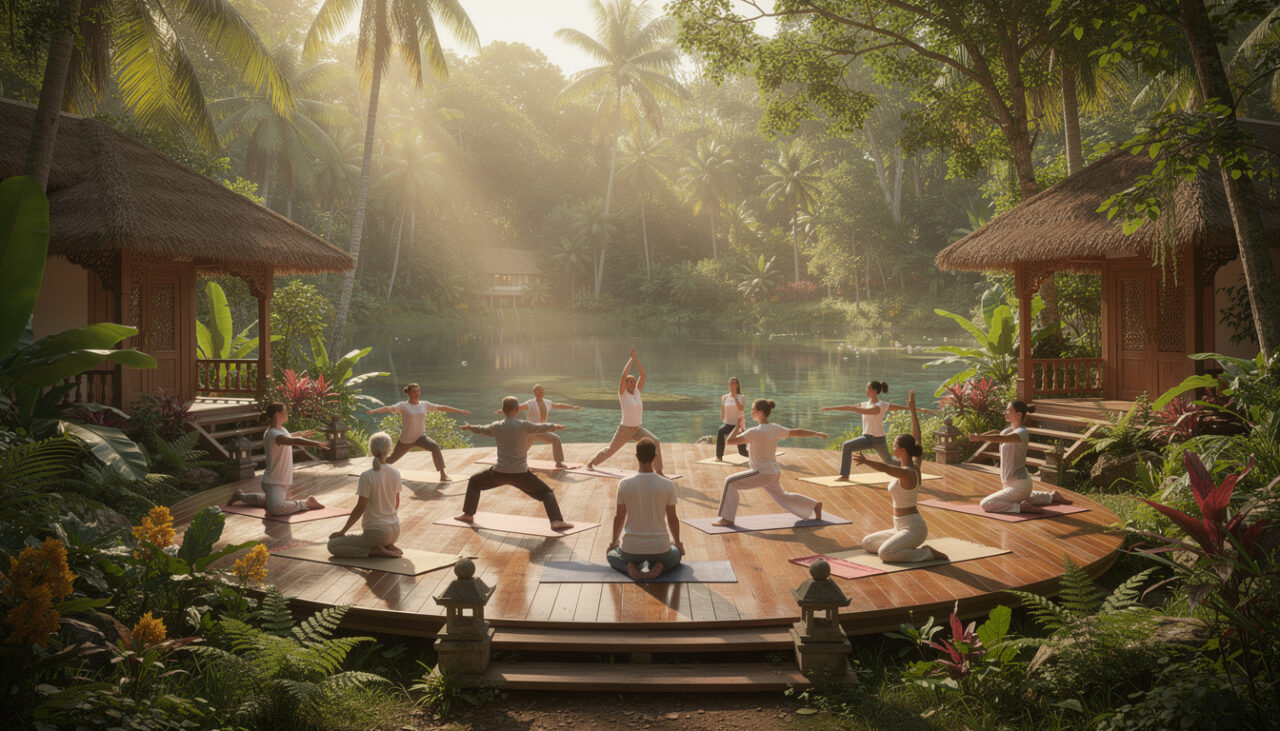
Picture a mid-range nature retreat near Kandy that blends Yoga, meditation, and gentle adventure. A bell rings at 6:15 a.m. as mist curls off the hills. Guests gather on a wooden deck for breathwork and a mellow Hatha flow overlooking a lake. After practice, breakfast appears: coconut sambol, red rice, jackfruit curry, and tropical fruit, eaten mostly in silence while dragonflies hover over the garden.
Late morning might bring an Ayurvedic consultation or a short workshop on stress, habit loops, or mindful communication. After a plant-based lunch, there’s time to nap in a hammock, read by the pool, or walk through nearby tea fields. Late afternoon invites a slow Yin class, followed by seated mindfulness while the sky turns copper. Dinner conversations drift from travel stories to personal turning points, and devices stay mostly forgotten in rooms.
By the time the lanterns are blown out, the body has been moved, fed, and heard. The nervous system has learned — not by lecture, but by repetition — that another way of living exists, at least for a while. That embodied experience becomes the real souvenir travelers pack in their backpacks when they leave.
Ayurveda, Spirituality and Mindfulness: The Deeper Layer of Sri Lankan Retreats
Beyond surf sessions and jungle shalas, many retreats in Sri Lanka tap into threads that run far deeper than modern wellness trends. Ayurveda, temple culture, and everyday spirituality shape the island’s approach to healing in ways that visitors can feel even if they don’t know the Sanskrit vocabulary.
Ayurveda, the ancient system of medicine that evolved on the subcontinent, treats health as a dynamic balance between body, mind, emotions, and environment. On the ground that translates into routines: warm oil massages that coax tension out of muscles and memories, herbal decoctions sipped morning and evening, and meals built around individual constitutions rather than one-size-fits-all diets. Guests at longer Ayurvedic retreats often start with tongue and pulse diagnosis, followed by lifestyle recommendations that cover sleep, exercise, spices, and even the timing of meditation sessions.
What surprises many is how grounding these practices feel when woven into daily life. A mid-level corporate manager, accustomed to skipping lunch and running on coffee, may find themselves eating at regular times, resting after meals, and going to bed earlier — not because a brochure told them to, but because their body finally has the space to notice what feels good. That experiential re-education can carry more weight than any wellness book.
Mindfulness in Sri Lanka isn’t limited to retreat centers. It shows up in the way a temple caretaker sweeps leaves from a whitewashed stupa at dawn, in the way villagers pause to light a single oil lamp after work, or in the careful preparation of rice and curry from garden vegetables. When retreats invite guests to join these rhythms — a Poya day visit to a hilltop shrine, or an offering of flowers before morning practice — spirituality stops being abstract and becomes something lived and ordinary.
For some travelers, this contact with embodied spirituality becomes the most transformative part of their stay. A software engineer from Toronto might arrive curious about handstands and leave more interested in how to cultivate patience, compassion, and presence back home. The outer practice becomes a doorway into inner work: watching thoughts in meditation, noticing reactions during difficult conversations at dinner, or exploring why stillness feels scary after years of constant motion.
Many retreats structure their programs to support that transition. Morning practices emphasize grounding — slow Sun Salutations, breath-focused standing postures, and short sits that build concentration. Evening sessions lean toward integration: Yin or Restorative Yoga, body scans, journaling prompts, or small group sharing circles. Over days, guests often notice subtle shifts: fewer spikes of anxiety, more curiosity toward discomfort, and gentler self-talk when postures or life events don’t look the way they expected.
Retreat leaders sometimes speak of a “forest effect”: the way being immersed in nature, away from devices and constant stimulation, naturally deepens mindfulness. Research from various parts of the world backs this up, showing how time in green spaces lowers cortisol, supports immunity, and improves mood. On the island, that might look like meditating under towering fig trees while monkeys rustle overhead or practising pranayama beside a waterfall that locals consider sacred.
Group dynamics add another layer. Many guests arrive alone, unsure whether they even belong in a Yoga space. Within days, they’re swapping life stories over herbal tea, lending each other sarongs for temple visits, and cheering first-time surfers on tiny waves. That sense of shared journey can be as healing as any massage. It reminds people that their struggles — burnout, heartbreak, self-doubt — are human, not personal failures.
By the end of a well-held program, participants usually leave not just with stronger bodies, but with new frameworks: redefined success that includes rest, relationships, and joy; an appreciation for slow mornings and phone-free evenings; and a clearer sense of what their own spirituality might look like beyond dogma.
Integrating Practice: Taking Sri Lanka Home With You
One concern travelers often carry is, “Will this peace vanish as soon as I get back to my old life?” Retreats on the island increasingly address that question head-on. Rather than framing the experience as a magical bubble, many facilitators treat it as a laboratory where guests can test drive habits they’ll later adapt to apartments and offices.
Practical tools help. Participants learn short morning sequences they can roll out on a hotel towel, five-minute breath practices for crowded trains, and micro-moments of mindfulness for commutes or tough meetings. Journaling prompts encourage them to identify specific changes they’re willing to commit to at home — a digital sunset, weekly nature walks, or one phone-free meal a day.
Some retreats even hold closing circles where each person shares one concrete promise to themselves. That act of voicing intention in front of witnesses turns vague hopes into living commitments. Back home, the memory of meditating under Sri Lankan stars or chanting softly in a jungle shala becomes a reference point — a reminder that a different nervous system state is possible, and that they’ve already lived it.
The deepest impact of these retreats isn’t a flawless Sun Salutation or perfect posture. It’s the quiet confidence that comes from having met oneself in silence, in sweat, and in stillness — and realizing that the same self travels home on the plane.
Practical Tips: Making the Most of a Yoga and Meditation Retreat in Sri Lanka
Once a traveler has picked the right program, a few grounded decisions can turn a good retreat into a deeply memorable one. Preparation, packing, and mindset each play their part, not as new sources of pressure but as gentle supports for the journey.
Start with expectations. Retreats are not vacations in the usual sense. There may be early mornings, challenging emotions, or periods of boredom as the mind comes down from constant stimulation. Approaching the experience with curiosity instead of demand — “What will I learn about myself?” rather than “This must fix everything” — softens the edges when tough moments arise. Planners who normally script every minute of a trip might treat this as an experiment in surrender.
Packing can stay simple. Lightweight clothing that covers shoulders and knees keeps both temples and sunburn at bay. A good sarong becomes a multi-tool: beach towel, shoulder wrap, temple cover, or makeshift blanket during cool dawn meditations. A notebook, pen, and perhaps a favorite small object from home (a photo, a crystal, or a tiny plant-pressed bookmark) ground guests in the familiar when inner work feels stormy.
Digital boundaries make a huge difference. Some retreats enforce full digital detox, while others simply suggest phone-free hours. Even in flexible spaces, creating your own rules — such as no phone until after breakfast, or flight mode during all practices — protects the experience from being diluted by notifications. Those extra pockets of boredom often become the moments when insights surface or conversations deepen.
Food is usually a highlight: fragrant curries, coconut-rich sambols, string hoppers, herbal teas, and piles of tropical fruit. Guests with allergies or special requirements should communicate clearly ahead of time, but many centers already cater well to vegetarian and vegan diets. Eating slowly, chewing thoroughly, and noticing the sensory detail of each meal turns dining into another mindfulness practice rather than just refueling.
Retreat etiquette is simple but powerful. Respect for silence during designated times, punctuality for sessions, and openness to local customs all support a harmonious group field. When things feel challenging — whether it’s physical discomfort in a pose or emotional release in meditation — speaking up to teachers allows them to adapt practices and offer support. The bravest guests are often those who raise a hand and say, “This feels like too much,” and discover that slowing down can itself be advanced practice.
After the retreat, re-entry deserves as much care as arrival. Instead of booking a red-eye flight that leaves right after closing circle, many travelers benefit from a buffer day or two: a quiet guesthouse, a slow train ride along the coast, or a final ocean swim in the south. That breathing space gives the nervous system time to integrate before facing inboxes and obligations again.
For those who catch the bug of contemplative travel, Sri Lanka often becomes one stop in a wider web of wellness journeys: from Yoga camps in Asia to mindful hikes in mountain cabins or cultural stays in other spiritual heartlands. The common thread is that each experience nudges life a little closer to what was felt during those long, bright island mornings on the mat.
Simple Pre-Retreat Rituals to Arrive Ready
A few weeks before flying to Sri Lanka, travelers can begin softening the landing with small tweaks at home. Reducing caffeine, going to bed half an hour earlier, and starting a five-minute daily breath practice prepare the body and mind for the upcoming shift. Those who normally sprint into holidays find that this gentle ramp-down makes the first retreat days less of a shock.
Writing down intentions — not as rigid goals, but as heartfelt wishes — can also clarify the journey. Lines like “May I rest,” “May I meet myself honestly,” or “May I reopen my creativity” serve as quiet companions during tougher stretches of the program. When fatigue or doubt arise, glancing back at those words reminds guests why they came.
By treating the retreat as a chapter rather than an isolated event, the entire arc — from first research to final flight home — becomes part of the practice. Sri Lanka simply offers an especially lush, generous setting for that story to unfold. 🌺