Packing Hacks for Long-Haul Flights to Asia
Long-haul flights to Asia can feel like a marathon in the sky: multiple time zones, packed cabins, dry air, and that strange mix of excitement and exhaustion. With the right packing tips, though, the journey turns from something to endure into a calm, almost spa-like transition between home and arrival. Smart travelers treat their carry-on as a tiny mobile sanctuary: layers for temperature swings, curated travel gadgets that actually earn their space, and snacks that keep energy up without the dreaded mid-flight crash. When packing connects comfort, organization, and a clear strategy for jet lag prevention, a 12‑hour haul to Tokyo or Bangkok stops feeling intimidating and starts to look like uninterrupted “me-time” above the clouds.
Key points about packing hacks for long-haul flights to Asia
- 🧳 Focus on carry-on essentials that support sleep, hydration, and relaxation on long-haul flights.
- 📦 Use luggage organization tools and space saving tricks so every item has a role and a reachable spot.
- 💺 Plan outfits and layers around flight comfort, cabin temperatures, and cultural norms on arrival in Asia.
- 🔌 Pack compact travel gadgets that solve real problems: power, noise, hygiene, and entertainment.
- 🕒 Build a simple jet lag prevention plan directly into what goes in your bag: sleep aids, timing tools, and snacks.
- 🌏 Let the destination guide your Asia travel packing: from wellness retreats in Thailand to hyper-urban stopovers in Seoul.
Strategic Packing Tips for Long-Haul Flights to Asia
Anyone who has done the London–Singapore–Bali shuffle knows that comfort starts at home, on the bedroom floor, where the suitcase is open and decisions are being made. Smart Asia-bound travelers think in scenarios: midnight layover in Doha, air‑conditioned terminal in Dubai, morning arrival in humid Ho Chi Minh City. Every item that ends up in the bag earns its place by answering a simple question: how will this make the journey easier, lighter, or calmer?
A fictional traveler named Maya offers a useful example. She’s flying from Toronto to Bangkok with a connection in Tokyo. On her first trip years ago, she stuffed her suitcase with “just in case” clothes and heavy books, leaving little room for what actually mattered during the flight itself. She landed groggy, dehydrated, and wearing jeans that felt like cardboard. Now, her packing looks almost minimalist, but every piece has a role—especially for those 15 hours in the air.
Her foundation: a light, soft backpack that counts as a personal item, paired with a standard cabin suitcase. The backpack holds everything she might need within arm’s reach: tech, toiletries, snacks, a scarf, and a change of base layers. The suitcase is more about the destination wardrobe and bulkier items. That split makes all the difference during boarding, late-night turbulence, or an unexpected gate change.
Carry-on essentials that transform flight comfort
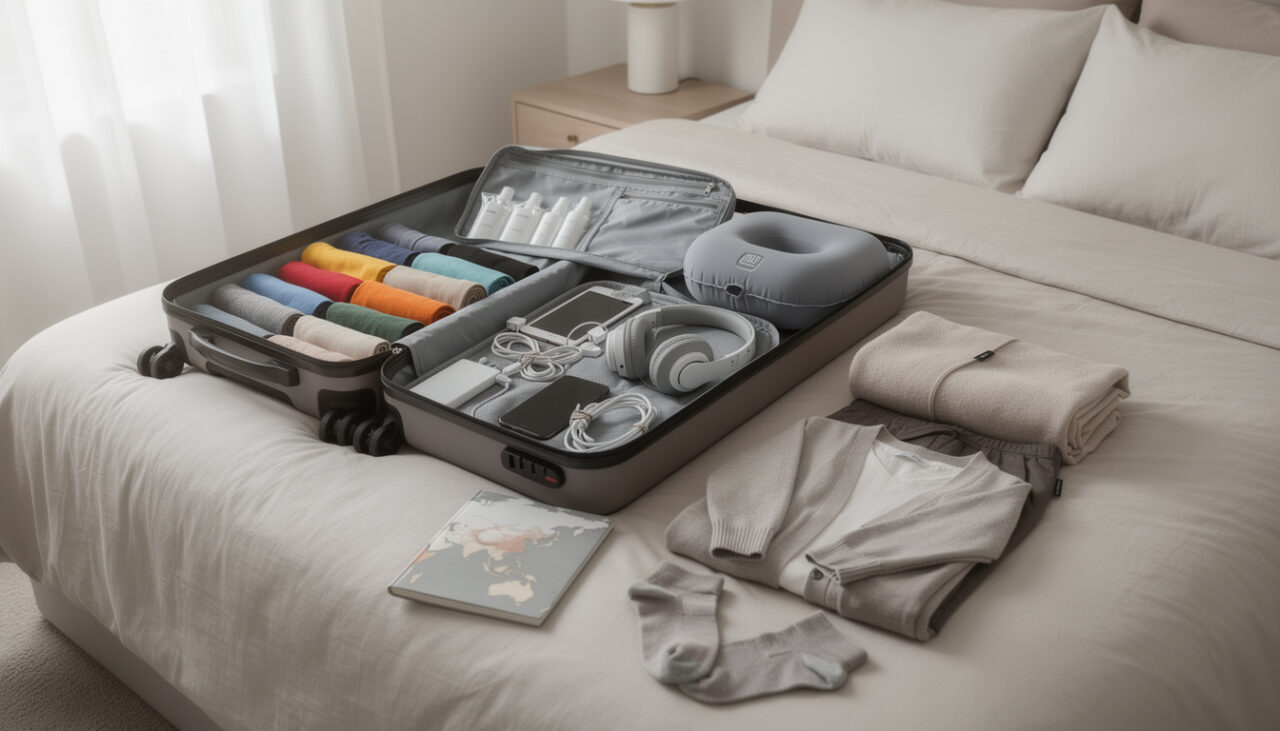
On very long-haul flights, the seat essentially becomes a tiny hotel room. Thoughtful carry-on essentials upgrade that “room” instantly. A soft, compressible neck pillow supports the head and shoulders; a large, airy scarf doubles as a blanket, shawl, or makeshift pillow; and a pair of cushioned socks or light compression socks keep circulation moving, especially across multiple time zones.
Noise and light are two of the biggest comfort killers. Packing a reliable pair of noise-cancelling earphones or over-ear headphones shrinks the roar of engines and chatter to a murmur. An eye mask with a soft, adjustable strap blocks overhead lights and the glare from a neighbor’s screen. These small items weigh almost nothing but can turn a chaotic cabin into a dark, quiet bubble.
Hydration belongs in the “non‑negotiable” category. An insulated water bottle, filled after security, keeps water cool for hours. Some travelers keep a tiny electrolyte sachet in a side pocket and mix it mid-flight, balancing the dryness of cabin air. The aim is simple: arrive feeling alive, not like a raisin with a passport.
Luggage organization and space saving tactics
Effective luggage organization helps prevent that dreaded moment when the lip balm is buried under a week’s worth of outfits. Packing cubes, zip pouches, and even simple cloth bags create zones: one small cube for in‑flight comfort (socks, mask, earplugs), another for tech, a third for toiletries. During a red‑eye to Seoul, being able to reach one cube with everything needed for “sleep mode” feels like having turn-down service at 35,000 feet.
For genuine space saving, travelers roll clothes instead of folding them and pair outfits by day, not by garment type. Tee + shorts + underwear roll together for Bangkok day one; linen shirt + light trousers + underwear roll together for a dinner in Singapore. That means less rummaging, fewer “what did I even pack?” moments, and faster transitions from plane to hotel lobby.
Multi-use fabrics help too. A lightweight merino T‑shirt can be worn multiple times without smelling, which frees up space and reduces laundry stress on the road. A long, packable jacket works as onboard warmth and as an evening layer once in Asia’s colder mountain destinations.
Planning for Asia travel specifics
Asia is a continent of microclimates and culture-rich contrasts. Packing for a wellness escape in Thailand is very different from preparing for winter in Hokkaido or a business trip to Hong Kong. When travelers head to beach-front retreats, they often draw inspiration from guides like wellness Thailand getaways, shaping their packing list around lightweight loungewear, resort-appropriate cover-ups, and swimwear that dries quickly in humid air.
For city breaks in Singapore, Osaka, or Kuala Lumpur, breathable fabrics win every time. Air-conditioned malls and subway systems can be chilly, while the streets outside can feel like a sauna. Layering solves the clash perfectly: a light cotton top, linen button-down, and a thin overshirt or shawl that can be removed in seconds.
Visa documents, printed hotel confirmations, and a simple paper copy of the passport tuck into a thin folder or envelope. It sits at the back of the backpack, easy to reach at immigration but not getting in the way during the flight. Efficient packing for Asia doesn’t scream “over-prepared”—it hums quietly in the background, smoothing every checkpoint and temperature change along the way.
All these choices—cubes, layers, compact comfort items—feed one clear outcome: a long-haul flight that feels less like a trial and more like a soft takeoff into the next chapter of the trip.
Designing a Personal In-Flight Comfort System
Comfort on Asia-bound long-haul flights rarely happens by accident. Travelers who consistently land in good shape treat the cabin like a controllable environment, not a mystery. They carry a repeatable “comfort system”: small items that manage temperature, posture, light, noise, and movement. The beauty of such a system is that it works whether the airline is full-service or a leaner carrier from a thorough budget airlines review.
The story of Elias, a frequent flyer between Berlin and Tokyo, shows what this looks like. Years ago he boarded in whatever he happened to be wearing that day and trusted the airline blanket. After a few flights shivering under a thin throw, neck aching, and eyes burning from dryness, he built a lightweight comfort kit that now lives permanently in his carry-on. The result: fewer aches, more sleep, and a lot less resentment toward red-eye flights.
Clothing layers and footwear that support flight comfort
Cabin temperatures can swing from chilly to stuffy, sometimes within one long-haul leg. A smart outfit for Asia-bound travel starts with breathable base layers: a soft T‑shirt or long-sleeve top in cotton or merino, plus stretchy joggers or relaxed chinos that don’t pinch at the waist. Tight waistbands and stiff seams become torture devices around hour nine.
On top, a light cardigan or zip hoodie acts as instant insulation. Many seasoned flyers add a thin down or synthetic vest that compresses into its own pocket. This tiny cloud of warmth keeps the core cozy without bulk in the sleeves, giving freedom to move or reach for the seatbelt.
Footwear matters just as much. Bulky boots steal legroom and add weight to the luggage. Slip-on sneakers or minimalist trainers strike a better balance. Once in the air, a pair of warm socks or compression socks replaces shoes, letting ankles breathe and reducing swelling. That small ritual—shoes off, socks on—signals the body that rest time has begun.
Creating a sleep-friendly bubble: lights, sound, and posture
Quality sleep on long-haul flights is part technique, part gear. The combination of a supportive neck pillow, eye mask, and earplugs works together like a portable bedroom. A U-shaped pillow suits back sleepers, while wrap-around styles support those who lean to the side against the window. Inflatable models save space and can be tweaked for firmness mid-flight.
Limiting light exposure nudges the body gently toward the new time zone. About two to three hours before the “target bedtime” at the destination, travelers dim their screen brightness, switch to calmer content like audiobooks or soft playlists, and slide on the eye mask. That makes the inevitable flicker of the neighbor’s movie or a passing cart far less disruptive.
Posture plays a quiet but powerful role. Adjusting lumbar support with a small cushion or folded blanket prevents lower back pain. A subtle footrest or even a bag placed under the feet improves circulation and eases pressure on the lower spine. Over long distances to Asia, these small ergonomic tweaks stack up to a major difference in how the body feels on landing.
Movement, stretching, and jet lag prevention
Prolonged sitting challenges the body’s circulation. A simple movement routine kept in mind—stand up every 60–90 minutes, walk the aisle, roll the ankles, stretch calves and hip flexors—helps prevent stiffness. Even in a full cabin, a few toe raises and shoulder rolls near the galley can loosen tight muscles and wake up the brain.
Good jet lag prevention begins before boarding. Many seasoned Asia travelers start nudging their sleep and meal times toward destination time a day or two earlier. Once on the plane, they set their watch or phone secondary clock to the arrival city. Meals and naps align with that new time rather than the departing country.
Hydration again supports this adjustment. Dehydration amplifies fatigue and headaches, both mistaken for pure jet lag. Herbal tea bags—camomile, peppermint—tucked into a small pouch give travelers a comforting ritual: ask for hot water, sip slowly, and unwind. The body reads these cues and starts recalibrating long before touchdown.
When a personal comfort system works, the cabin no longer feels like a test of endurance. It becomes a manageable, even peaceful, in-between space connecting life chapters on either side of the world.
Smart Travel Gadgets and Tech for Long-Haul Flights
Tech can distract, entertain, and rescue, but it can also weigh down a bag if chosen badly. The sweet spot for long-haul Asia travel is a tight, intentional tech kit that powers entertainment, communication, and comfort while staying light and easy to recharge. The guiding rule: every gadget needs a clear job and a sensible size.
Consider Lina, flying from Paris to Seoul with a quick transfer in Istanbul. Years ago, she boarded with a laptop, tablet, e‑reader, DSLR, two power banks, and a nest of cables. Halfway through the trip, she realized she had turned her seat into a tech warehouse. Now, her setup is stripped back: a smartphone, lightweight tablet, compact power bank, noise-cancelling headphones, and a single multiport USB cable. Her shoulders are happier, and so is airport security.
Choosing and organizing essential travel gadgets
A well-curated tech pouch feels like carrying a mini command center. A 10,000 mAh power bank sits at the heart of it, strong enough to recharge a phone two or three times but still acceptable on most airlines without extra scrutiny. One short USB‑C cable, one Lightning or equivalent cable, and a tiny wall adapter with multiple ports cover almost every charging scenario.
Noise-cancelling headphones double as a wellness tool. They create a calmer soundscape, whether the cabin is full of crying infants or late-night chatter. Over-ear styles cushion the ears for hours, while in-ear options pair well with eye masks for side sleepers. A simple airline audio adapter lets these headphones plug into older in-flight entertainment systems, avoiding flimsy complimentary headsets.
Tablets or e‑readers hold movies, series, and whole digital libraries without stealing precious space. Downloading content before the airport avoids dependence on unpredictable Wi‑Fi. Podcasts and language-learning apps fill shorter windows of wakefulness, turning layovers into casual mini-classes en route to Tokyo or Hanoi.
Digital planning tools and flight-friendly apps
Smartphone apps quietly orchestrate smoother long-haul itineraries. Flight trackers send gate change alerts, while airline apps handle boarding passes and seat changes. Frequent travelers often rely on cheap global flight apps not just for booking, but for monitoring alternate routes in case of disruption.
Time zone apps visualize sleep windows across continents. Before a Kuala Lumpur trip, for instance, a traveler can check how shifting bedtime by one hour on two nights pre-departure makes the arrival adjustment gentler. Meditation or breathing apps become a digital sleep coach when nerves or excitement make rest elusive.
Document scanners keep backups of passports, visas, and vaccine certificates. Keeping these in a secure, offline app means less panic if a paper copy gets buried or a bag has to be gate-checked unexpectedly. On Asia-bound flights with multiple border checks or health forms, that level of organization unknots a lot of tension.
Tech etiquette and preserving battery life
Cabins are shared spaces, and thoughtful tech habits keep them pleasant. Screen brightness at a low but readable level spares seatmates from unwanted glare. Headphone volume stays just high enough for clear audio, not so loud that the next row hears the movie soundtrack.
Battery management starts from boarding. Airplane mode goes on, Bluetooth stays only if needed for headphones, and background apps are closed. Many travelers switch their phone display to dark mode to conserve energy on OLED screens. For very long segments, a simple hierarchy keeps things efficient: first, use the power from the seat outlet if available; second, the power bank; last, the internal battery.
Smart tech use makes the flight feel shorter without turning the tray table into a spiderweb of cables. The goal isn’t to replicate a home office in economy—it’s to create a balanced, low-stress digital cocoon where entertainment, sleep, and planning all feel within reach.
Carefully chosen gadgets, paired with respectful use and lean organization, help long-haul flights feel less like digital chaos and more like a quiet, curated retreat at 11,000 meters.
Food, Hydration, and Wellness Rituals in the Air
Food and drink onboard often decide whether arrival in Asia feels refreshed or foggy. Salty snacks, sugary drinks, and endless coffee might sound tempting at cruising altitude, yet they quietly sabotage sleep and hydration. A mindful approach to in-flight eating turns the cabin into a wellness extension of the destination, whether that’s a detox break in Chiang Mai or a temple stay in Kyoto.
Travelers who arrive glowing instead of drained build simple rituals: when to eat, what to snack on, how to hydrate, and how to move. These rituals don’t require elaborate prepping; they just ask for a bit of intention when packing and choosing from the meal trolley.
Smart snacks and in-flight meal strategy
Airport shops lure travelers into last-minute bags of chips and giant candy bars. Those hits of salt and sugar spike energy before dropping it into a valley of sluggishness. A better approach starts at home, with a small snack kit: nuts, seeds, low-sugar granola bars, dried fruit, and perhaps some dark chocolate squares. 🍫
These foods deliver steady energy without flooding the system. Packing them in resealable bags controls portions and keeps crumbs in check. Onboard, travelers can accept the main meal from the airline but skip the second heavy snack, replacing it with the packed options instead. That balance keeps digestion calmer—useful when the next stop after landing is a night market feast in Taipei or Bangkok.
- 🥜 Mixed nuts and seeds for healthy fats and steady fuel
- 🍎 Dried fruit for gentle sweetness and fiber
- 🍫 Dark chocolate squares as a mood-lifting treat
- 🍪 Low-sugar oat or nut bars for convenient mini-meals
- 🍵 Herbal tea bags for a soothing pre-sleep ritual
Hydration, skin care, and cabin dryness
Cabin air dehydrates skin and mucous membranes quickly, making lips crack and eyes sting. An easy routine counters that. A reusable bottle, filled after security, sits in the seatback pocket. Sipping small amounts consistently beats chugging a full bottle once an hour. Some travelers aim for a cup of water every hour they’re awake on the plane.
Skin care shrinks down to essentials. A travel-sized gentle moisturizer, a hydrating lip balm, and a tiny facial mist keep the face comfortable. Wet wipes handle quick freshen-ups after naps or before landing. A small, soft towel or handkerchief acts as a multipurpose cloth, especially useful for hot water compresses over tired eyes.
Eyes dry out quickly in the filtered air, particularly for contact lens wearers. Many swap lenses for glasses before boarding Asian routes longer than eight hours. A miniature bottle of preservative-free eye drops tucked in the toiletry pouch brings instant relief during a movie binge or late-night reading session.
Movement, stretching, and mental reset rituals
Wellness on long-haul flights reaches beyond the physical. The mind also needs outlets. A compact journal and pen create space to process anticipation—listing must-try ramen shops in Tokyo, sketching a temple silhouette, or writing a quick recap of the departure day. ✍️
As for the body, simple stretches performed in the aisle or near the galley keep blood flowing. Calf raises, gentle hamstring stretches, twists for the lower back, and shoulder circles break the pattern of stillness. Setting a quiet vibration-only reminder every 90 minutes nudges movement without disrupting neighbors.
Breathing exercises ease anxiety and help sleep arrive faster. A 4‑7‑8 rhythm (inhale for four counts, hold for seven, exhale for eight) repeated a few times encourages relaxation. That rhythm pairs well with dimmed screens, lowered seatback, and the comforting weight of a blanket or scarf over the legs.
| 🕒 Flight phase | 🍽️ Food & Drink Focus | 🧘 Wellness Habit |
|---|---|---|
| Pre-boarding | Light meal, sip water, avoid excess caffeine | Short walk through terminal, gentle stretches |
| First 2 hours in air | Accept main meal, drink water, skip extra alcohol | Organize seat area, set destination time on devices |
| Mid-flight | Healthy snacks 🥜, herbal tea, steady hydration | Walk the aisle, ankle rolls, mindful breathing |
| Pre-landing | Small snack if hungry, light water intake | Freshen up, simple stretches, mental review of arrival plans |
When food, water, movement, and quiet mental breaks are all woven into the hours in the air, the plane becomes less of a suspended limbo and more of a gentle runway into the experiences waiting across Asia.
Thoughtful onboard rituals connect directly with how the first day on the ground feels—energetic enough for a stroll along the Chao Phraya, or at least awake enough to resist a bed until local evening.
Destination-Driven Packing Hacks for Asia
Long-haul packing gets truly powerful when the destination shapes every choice. Asia offers stark contrasts: icy winds in Sapporo, jungle heat in Bali, polished boardrooms in Singapore, and laid-back beaches in southern Thailand. The trick lies in building a kit that feels at home in the cabin and yet adapts once the plane doors open.
Consider a traveler tracing a path from London to Bangkok, then on to Chiang Mai for a wellness retreat. The same hand luggage that served as a sleep cocoon on the plane becomes a daypack for temple visits and café hopping. Smart choices before departure turn every item into a small piece of a bigger puzzle.
Packing for wellness retreats, city stops, and side trips
For spa-focused escapes and slow days by the pool, airy layers and easy-to-rinse fabrics dominate the suitcase. Flowy pants, breathable tees, and a couple of swimsuits form a flexible base. A light kimono-style cover-up doubles as loungewear and as a modest layer for breakfast buffets or quick lobby visits.
City stays in Tokyo, Seoul, or Shanghai ask for slightly sharper pieces: one or two structured shirts, neat trousers, and comfortable yet stylish shoes for walking. Rolling these garments and grouping them by use (city, beach, temple) keeps outfits intentional and prevents overpacking “just in case” pieces.
Day trips—whether to mountain temples in northern Thailand or street markets in Hanoi—benefit from a compact day bag that folds flat in the suitcase. Once on the ground, it carries sunscreen, a small umbrella, water, and a scarf used earlier as an in-flight blanket. The same packing logic ensures that flight items remain useful throughout the journey.
Adapting to cultural norms and climate shifts
Cultural sensitivity travels well. Many sacred sites across Asia ask visitors to cover shoulders and knees, regardless of the outside temperature. Packing one or two below-the-knee skirts or loose trousers and a light, opaque scarf solves this elegantly. These pieces sit ready near the top of the suitcase, not crushed under heavy layers.
Climate changes between legs of the trip deserve equal attention. Landing in humid Singapore from a cold European winter can shock the body. Layering solves that: a warm outer jacket worn onto the plane can be removed in steps—first jacket, then hoodie—until only the breathable base layer remains suitable for the tropical air.
Winter routes to Asia, like flights toward Hokkaido’s snowy landscapes, reverse that logic. Thermal layers serve as sleepwear on the plane, with thicker outerwear stored in overhead bins. Gloves and hats ride in the personal item so they are reachable before stepping into cold air at the arrival gate.
Reusing pieces and keeping luggage light
Minimalism shines when hopping between Asian destinations. Re-wearable fabrics such as merino or performance blends keep luggage lighter while staying fresh. A small sink laundry kit—travel-sized detergent, a universal sink stopper, and a clothesline—makes it easy to refresh a shirt or two during a layover or quiet evening.
Some travelers discover new routes and companions en route, often inspired by communities like those described in solo travel stories on solo travel friends. Shared laundry sessions at hostels or guesthouses turn into mini social rituals, reinforcing how a light bag can still support a rich, spontaneous itinerary.
Every reused garment, every multi-purpose scarf, and every repeat-wear pair of shoes represents both saved space and freed mental energy. The suitcase becomes a supportive companion rather than a burden to drag from station to station across Asia’s vast rail and metro networks.
When destination-driven thinking guides what goes into the case, long-haul flights become the smooth, well-packed bridge between one world and another—never a roadblock.